AI-readiness audit
Assessing how your current content and site structure appear to AI crawlers and language models

Search no longer ends at a list of blue links. When someone asks Google's AI Overviews, ChatGPT, or Perplexity a question, only a handful of sources get cited in the answer - and if your business isn't structured to be one of them, you're invisible at the exact moment a customer is deciding who to trust. Vibrant Info's GEO (Generative Engine Optimization) and AIO (AI Optimization) services prepare your content and site structure to be found, understood, and cited by AI-driven search - alongside, not instead of, traditional SEO.
Delivering secure, scalable GEO/AIO - AI Search Optimization systems for enterprise teams already running Microsoft-stack infrastructure.
Generative Engine Optimization (GEO) is the practice of structuring content so AI search tools can accurately extract, summarize, and cite it. AI Optimization (AIO) is the broader discipline of making your entire digital presence - site structure, schema, content clarity - legible to AI systems, not just search crawlers. Together, they determine whether your business shows up when someone asks an AI assistant a question instead of typing a search query.
| Traditional SEO | GEO/AIO | |
|---|---|---|
| Goal | Rank in the 10 blue links | Get cited inside AI-generated answers |
| Where it shows up | Google, Bing search results pages | AI Overviews, ChatGPT, Perplexity, Gemini, voice assistants |
| Content shape that wins | Keyword-optimized pages | Clearly structured, directly-answerable, well-sourced content |
| Key signals | Backlinks, on-page keywords, site speed | Structured data, clear entity definitions, citation-worthy facts, topical depth |
As a full-service GEO/AIO development agency, we provide comprehensive services across web, enterprise, and desktop applications.
Assessing how your current content and site structure appear to AI crawlers and language models
Rewriting key pages so they answer questions clearly and completely, the way AI engines prefer to cite
Implementing and expanding schema so AI systems can accurately parse who you are and what you offer
Strengthening the signals (consistent NAP, citations, Wikidata/Knowledge Panel presence) that help AI systems recognize your brand as a credible source
Monitoring whether and how your brand appears in AI Overviews and conversational search results
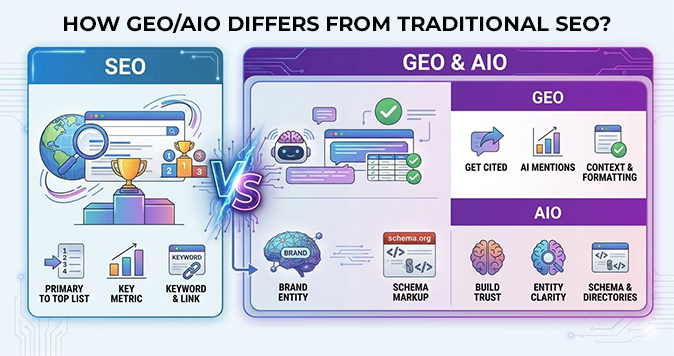
Search behavior is shifting faster than most businesses' websites are. A page built purely for keyword rankings often fails the far stricter bar AI engines apply: is this content clear, well-sourced, and directly answering the question asked? Businesses that get ahead of this shift now — while most competitors are still optimizing for 2019-era SEO — have a real window to establish citation authority before the space gets crowded.
A senior pod of engineers, designers and a product lead — fully embedded in your team and accountable to your outcomes.
Workshops, requirements and a clear, costed roadmap.
Production-grade code shipped weekly with full transparency.
QA, deployment, monitoring and post-launch iteration.
Yes - they work together, not in place of each other. Traditional SEO still drives the majority of search traffic today, but AI-generated answers are capturing a growing share of queries, especially informational ones. GEO/AIO ensures you're not left out of that share.
We track whether and how your brand is cited in AI Overviews and tools like ChatGPT for relevant queries, alongside standard organic traffic and ranking metrics, since AI citation tracking is still an emerging measurement space.
No - if anything, smaller and mid-sized businesses benefit more, since AI engines often surface specific, well-sourced answers over generic large-brand content when the smaller source answers the question more precisely.